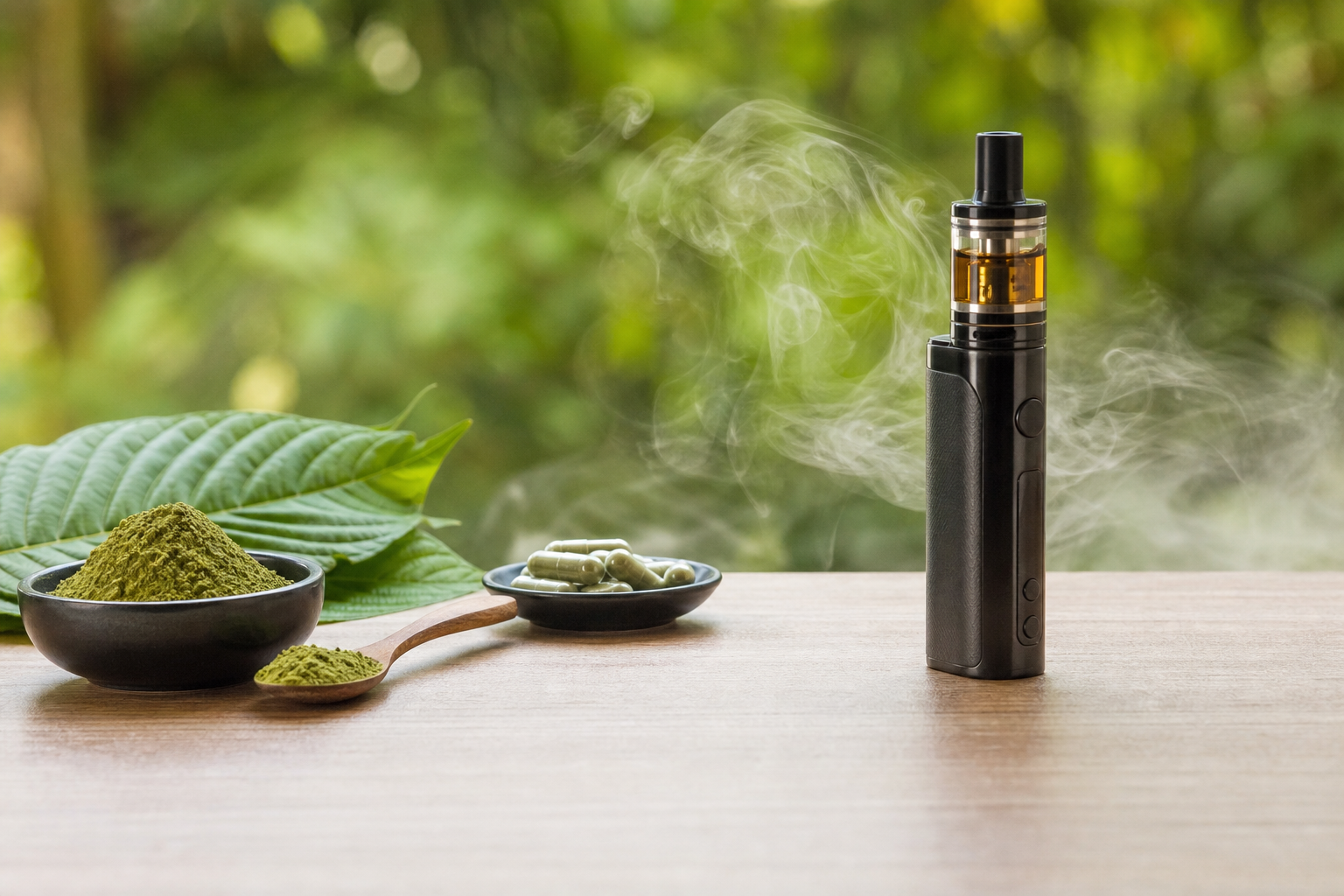
Kratom is most commonly associated with oral preparations made from the leaves of Mitragyna speciosa. As vape-oriented products and online discussions have expanded, some consumers have begun asking whether a kratom vape offers a meaningful alternative to more familiar preparations.
The short answer is that vaping kratom and taking kratom orally are fundamentally different routes of exposure, with very different levels of history, product standardization, and safety knowledge. Traditional forms have their own risks, but kratom inhalation introduces substantial uncertainty that shoppers should not overlook.
Traditional oral forms: powder, capsules, and extracts
The best-known kratom consumption methods involve swallowing a preparation made from the leaf. Kratom powder may be mixed into a beverage or food, while kratom capsules package that same powder in a measured-looking format. Neither format is automatically consistent from one product or batch to another, but both follow the basic route by which kratom has historically been used.
When swallowed, kratom’s active alkaloids pass through the digestive system and are processed by the body before entering circulation. Effects tend to develop more gradually than they would with inhaled substances, and they can last for a relatively extended period. Food intake, individual metabolism, product composition, and other substances can all affect the experience.
Kratom extracts are different from plain leaf powder. They concentrate selected compounds or a broader alkaloid profile from the plant material. That concentration can make extracts more potent and less forgiving than ordinary leaf products. Labels that emphasize ratios, enhanced strength, or milligram quantities deserve particular caution, especially when the product does not clearly explain what those figures represent.
Capsules can be convenient and can avoid the bitter taste associated with powder, but convenience should not be mistaken for predictability. A capsule’s appearance does not establish its contents, purity, or strength. Powder has similar quality-control concerns, including possible contamination, inaccurate labeling, and batch-to-batch variation.
What changes with a kratom vape
A kratom vape generally refers to a device or liquid marketed as containing kratom-derived material or kratom-associated compounds for inhalation. Unlike oral leaf products, this category does not have a long, established tradition of use. It also raises a basic technical question: whether the relevant plant compounds can be delivered through an aerosol in a stable, reliable form without being damaged by heat or mixed with other ingredients that create their own hazards.
With herbal vaping, heating is not a minor detail. Plant constituents can break down, change chemically, or fail to vaporize effectively at device temperatures. The aerosol produced by a cartridge or disposable device may also contain carrier liquids, flavorings, thinning agents, metals, or thermal byproducts. A label saying “kratom” does not reveal which compounds are actually reaching the user’s lungs.
This makes kratom inhalation harder to assess than simply translating an oral dose into a vape format. The two routes are not interchangeable. A product’s stated extract amount, if it provides one at all, does not tell a consumer how much active material is delivered per puff or how much is absorbed.
Onset, duration, and the temptation to redose
The contrast between oral and inhaled use often comes down to timing. Oral preparations usually have a slower onset because digestion and metabolism are involved. That delay can lead some people to take more before the original amount has fully taken effect, creating a risk of unintended overconsumption.
Inhaled substances often produce faster perceived effects because compounds can enter the bloodstream through the lungs. But faster delivery is not necessarily safer or more controllable. A rapidly acting product may encourage repeated use in a short window, particularly if the effect is subtle, inconsistent, or fades quickly.
For kratom specifically, there is limited dependable information about the pharmacology and real-world effects of inhaled commercial products. Claims that vaping produces “cleaner,” “stronger,” or “safer” kratom effects should be treated as marketing unless supported by transparent, product-specific testing and credible evidence. A faster onset is not proof of better quality.
The evidence gap matters
Kratom itself has an evolving safety and regulatory landscape. It can produce adverse effects, may lead to dependence in some users, and can interact with medications, alcohol, and other drugs. Serious outcomes have been reported in contexts involving kratom, particularly where other substances or unknown product contents are involved.
The evidence base becomes thinner when the subject is vaping kratom. Research and safety information surrounding oral leaf and certain alkaloids do not automatically apply to heated aerosols. Lung exposure introduces risks that are separate from digestive exposure, including airway irritation and possible harm from inhaling solvents or contaminants.
That uncertainty is especially important for people with asthma, chronic lung conditions, cardiovascular concerns, liver problems, a history of substance-use disorder, or sensitivity to stimulants or sedating substances. Pregnancy and breastfeeding are also circumstances in which avoiding kratom products is the prudent choice.
Product transparency is more important than novelty
Consumers considering any kratom product should prioritize transparency over format. For oral products, that means clear ingredient lists, batch identification, and independent testing that addresses contaminants and verifies the product’s stated composition. For a vape product, the standard should be even higher: consumers should know every ingredient in the liquid or extract, the nature of the carrier, and whether testing addresses both the starting material and the aerosol produced during use.
A vague “proprietary blend,” unsupported health claims, or a label that does not distinguish kratom extract from generic botanical flavoring are warning signs. So are products that frame inhalation as a harmless wellness shortcut or imply that plant-derived automatically means lung-safe.
Legality is another separate consideration. Kratom rules vary by jurisdiction, and regulations concerning inhalable products can add another layer of restrictions. A product being sold online or in a retail shop does not settle its legal status where the buyer lives.
A cautious decision framework
For someone weighing traditional kratom consumption methods against a vape, the key distinction is not simply convenience. Oral powder, capsules, and extracts have known concerns around potency, contamination, interactions, and dependence, but they are at least recognizable forms with a longer record of use. Kratom vaping adds uncertainty about heating, aerosol chemistry, inhaled ingredients, and the actual delivery of active compounds.
That makes a kratom vape a poor choice for anyone seeking a well-characterized or lower-risk way to use kratom. Avoid combining kratom with alcohol, opioids, benzodiazepines, stimulants, or other substances that can complicate its effects. Anyone experiencing trouble breathing, chest discomfort, severe vomiting, confusion, loss of consciousness, or other alarming symptoms after using kratom should seek urgent medical help.
Kratom safety begins with recognizing the limits of what a product label can tell you. Novel delivery systems may look simpler than measuring powder or swallowing capsules, but when the route is inhalation, the unanswered questions deserve more weight than the convenience.