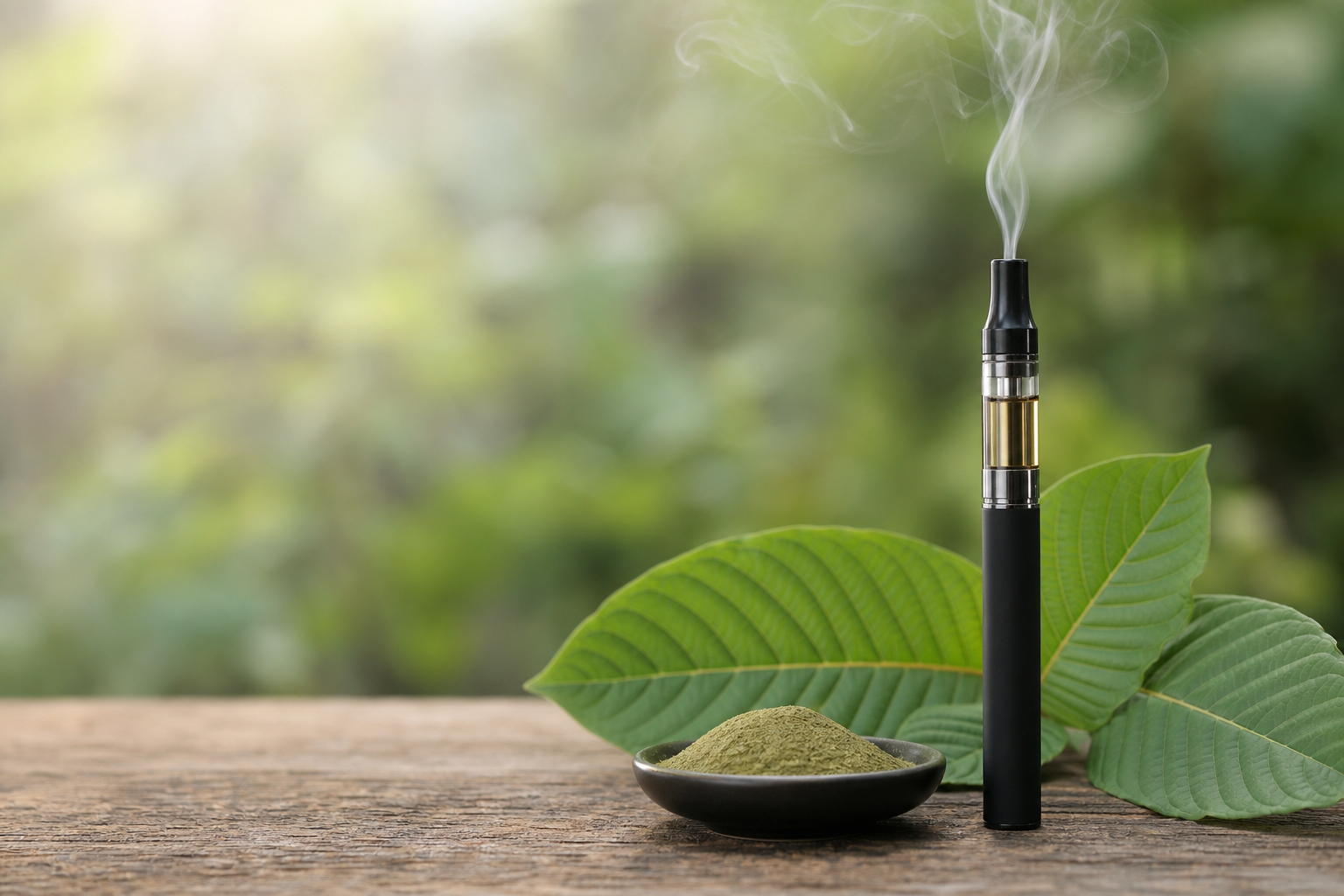
Kratom is most commonly discussed as a leaf-based botanical taken by mouth. Vaping changes the route of exposure, the chemistry involved, and the kinds of problems a consumer needs to consider. That distinction matters because a product can be marketed as “herbal” or “natural” while still creating significant uncertainty when heated and inhaled.
For people considering kratom vaping, the most useful starting point is simple: do not assume that a kratom product made for oral use is suitable for a vape device, and do not assume a product labeled for vaping has been adequately evaluated for inhalation.
Why inhalation changes the question
Kratom contains naturally occurring compounds commonly called kratom alkaloids. When kratom is swallowed, those compounds move through the digestive system and liver before producing effects. Inhalation can expose the lungs and bloodstream differently, potentially changing onset, intensity, and risk.
Heating also matters. A plant extract that is stable enough in a capsule, powder, or liquid may behave very differently in a cartridge or vaporizer. Heat can alter compounds, create degradation byproducts, or interact with the carrier liquids, flavorings, metals, and other materials in a vaping system.
There is limited dependable information about what happens when kratom alkaloids and the other ingredients in kratom vape products are repeatedly heated and inhaled. That uncertainty alone is a consumer safety concern, especially for frequent use or high-powered devices.
The myth that “vapor” means harmless
One persistent myth around herbal vaporization is that it is inherently safe because it is not the same as smoking. It is true that vaporization and combustion are different processes. But “not smoke” does not mean “risk-free.”
A vapor can contain substances from the original material, chemicals formed during heating, and compounds released from the device or liquid. The amount and makeup can vary with temperature, coil condition, power setting, liquid composition, and how a person uses the device.
This is one reason vape safety cannot be judged from a label claim alone. Terms such as “clean,” “pure,” “botanical,” and “solvent-free” may sound reassuring, but they do not establish that a formulation is appropriate for the lungs. Consumers should be particularly cautious with vague proprietary blends and products that do not clearly identify every ingredient.
Kratom extract is not automatically vape-ready
Kratom extract is a broad term, not a guarantee of quality or suitability. Extracts can differ substantially in concentration, processing method, alkaloid profile, residual plant material, and added ingredients. An extract intended for oral products may be too thick, unstable, contaminated, or otherwise unsuitable for a cartridge.
Trying to make a homemade kratom e-liquid by mixing powder or extract into a vape base creates additional problems. Powders may not dissolve evenly. Plant particles can clog devices or be carried into the aerosol. Common vape ingredients do not necessarily make an herbal preparation safe to inhale. Adding oils, unknown diluents, or flavor concentrates compounds the risk.
A consumer should avoid modifying a vape product with kratom powder, tincture, tea, capsule contents, or oral extract. “It fits in the tank” is not a meaningful safety standard.
What may be in a kratom vape product?
The central issue is not just whether a product contains kratom. It is also what else is present and whether the contents match the label. Potential concerns include:
- Unclear alkaloid concentration or inconsistent batches
- Carrier liquids and flavorings with uncertain inhalation effects
- Contaminants from poor manufacturing or storage
- Residues from extraction or thinning agents
- Ingredients that are not disclosed, including other psychoactive substances
- Hardware-related exposure from damaged coils, overheated cartridges, or poor-quality components
Reliable, product-specific testing can reduce uncertainty, but a certificate is only useful if it clearly corresponds to the actual batch and reports meaningful results. A generic document, an image without batch identification, or a claim that testing occurred is not the same as transparent quality control.
Vaping risks can increase with mixing and escalation
People sometimes turn to vaping because they expect a faster effect or easier dose adjustment. In practice, rapid delivery can make it easier to take repeated puffs before fully recognizing the effects. A concentrated or poorly characterized formulation makes that problem harder to manage.
Combining kratom with alcohol, sedatives, opioids, stimulants, or other substances can add unpredictable strain and may raise the chance of serious adverse effects. The same caution applies to combining multiple kratom products, such as using an extract vape alongside capsules, shots, or powders. Keeping track of total exposure is difficult when products use different forms and labeling conventions.
People with heart, lung, liver, mental health, or substance-use concerns should be especially careful about experimenting with inhaled products. Pregnancy and breastfeeding are also circumstances where avoiding nonessential, poorly studied exposures is the prudent choice. Anyone taking prescription medication should discuss potential interactions with a qualified clinician or pharmacist rather than relying on marketing material or social media anecdotes.
Vape device safety still matters
Even a clearly labeled liquid can become riskier in an unsafe device. Vape device safety includes using compatible cartridges and batteries, avoiding damaged equipment, and not using products that leak, smell burnt, discolor unusually, or cause immediate irritation.
Do not keep using a cartridge that produces a harsh, metallic, or burnt taste. That can indicate overheating, a degraded coil, or a formulation problem. Avoid using unverified chargers, damaged batteries, or loose cells. Store products away from children and pets, since liquids and concentrates can be hazardous if swallowed or spilled.
A severe cough, chest pain, shortness of breath, fainting, confusion, severe agitation, persistent vomiting, or an irregular heartbeat warrants prompt medical attention. If someone may have swallowed a vape liquid or has had a concerning exposure, contact local emergency services or a poison information service without delay.
A practical kratom consumer guide for vape decisions
Responsible kratom use begins with accepting uncertainty rather than trying to vape around it. If a person is still evaluating a product, the safer questions are not “Does it hit hard?” or “Is it all-natural?” They are:
- Is every ingredient and the intended route of use plainly disclosed?
- Is there credible batch-specific quality information?
- Is the manufacturer making medical or guaranteed-effect claims that should raise concern?
- Does the product encourage mixing with other substances or unusually frequent use?
- Is there a reason to choose an inhaled product when the inhalation risks are unclear?
For many consumers, the last question is decisive. The evidence gap around kratom vaping, combined with ordinary vaping risks and product-quality uncertainty, makes caution more sensible than experimentation. A label’s promise of convenience should not outweigh the need for transparent ingredients, reliable manufacturing, and a route of use that is better understood.