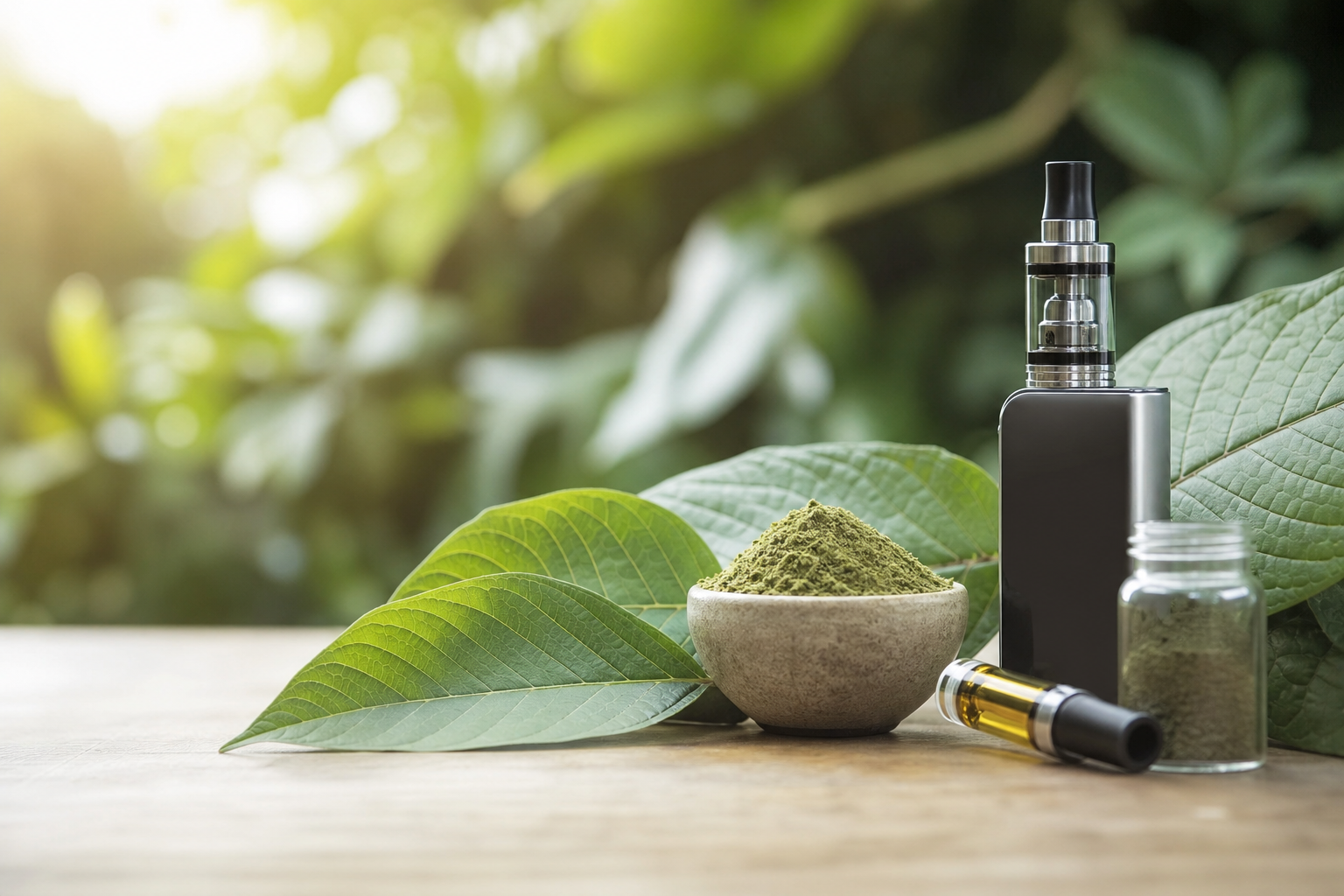
Kratom and vaping are often discussed together, but the pairing can create more confusion than clarity. Kratom has traditionally been consumed as leaf powder, tea, capsules, or standardized extracts. Vaping involves heating a liquid or other material into an aerosol for inhalation. Those are very different delivery routes, with different product standards, risks, and unanswered questions.
For consumers, the most useful starting point is simple: do not assume that a product marketed as a “kratom vape” has the same effects, ingredients, or safety profile as conventional kratom preparations. Labels and marketing language may be incomplete, and the science around inhaled kratom constituents remains limited.
What “Kratom Vape” May Actually Mean
The term kratom vaping can describe several different products. Some are e-liquids or disposable devices claiming to contain kratom-derived ingredients. Others may contain botanical flavoring, hemp-derived compounds, nicotine, caffeine, synthetic ingredients, or blends that have little resemblance to traditional kratom leaf.
A product can use kratom imagery or language without providing meaningful information about what is inside. A consumer should not treat the word “kratom” as proof that a vape contains identifiable kratom alkaloids, a disclosed dose, or tested ingredients.
Kratom extracts add another layer of uncertainty. Extracts are concentrated preparations that can vary greatly in composition. In a conventional oral product, a responsible manufacturer may identify the extract ratio or quantify key alkaloids. In a vape, the question is not only what the extract contains, but whether it remains stable when heated and whether it can be safely formulated for inhalation.
Those are separate issues. An ingredient that is acceptable to ingest is not automatically suitable to inhale.
Why Inhalation Changes the Safety Question
With oral kratom, the digestive system and liver influence how compounds are absorbed and processed. Inhalation sends an aerosol into the respiratory system, potentially producing faster delivery and exposing the lungs to both active ingredients and heating byproducts.
There is limited reliable information on how kratom’s primary alkaloids behave when heated in vape hardware, how much reaches the bloodstream through inhalation, or what repeated respiratory exposure may do. That uncertainty should be central to any discussion of kratom vape safety.
Vapor products may also contain solvents, flavorings, thinning agents, metals from heating components, or contaminants introduced during manufacturing. Some substances are commonly used in food or topical products but have not been established as safe for inhalation. Heat can also change ingredients and create additional compounds.
Known vape health risks are not limited to nicotine. They include potential respiratory irritation, dependence where nicotine is present, exposure to contaminants, and harm associated with poorly made or illicit products. Adding an under-researched botanical extract does not remove those risks; it makes product evaluation more difficult.
People with lung disease, heart conditions, liver concerns, a history of substance-use disorder, or sensitivity to stimulants or sedating substances should be especially cautious. Combining a kratom-labeled vape with alcohol, opioids, benzodiazepines, stimulants, or other psychoactive drugs can add unpredictable risk. Avoid driving or operating machinery after using any product that may affect alertness or coordination.
Labels Matter, but Testing Matters More
A detailed label is not a guarantee of quality, but a vague label is a clear warning sign. Before considering herbal vape products, consumers should look for meaningful information rather than broad claims such as “natural,” “plant-based,” or “lab tested.”
Useful disclosures include:
- A complete ingredient list, including carrier liquids, flavorings, nicotine, cannabinoids, and other active ingredients.
- The identity and amount of kratom-derived compounds, if the product claims to contain them.
- A batch or lot number that connects the device or bottle to testing records.
- Independent laboratory results that address identity, potency, heavy metals, pesticides, microbes, and residual solvents where relevant.
- The manufacturer’s name and a practical way to contact the company.
Be wary of products that promise dramatic effects, claim to treat medical conditions, obscure the presence of nicotine, or present a proprietary blend without quantities. A QR code alone is not enough if it leads to a generic certificate that does not match the specific batch.
Consumers should also be alert to mismatched terminology. A product described as “kratom extract” should not be assumed to contain whole-leaf kratom, and a “botanical” vape may contain no kratom at all. If a company cannot clearly explain what it sells, the safer choice is not to inhale it.
Kratom Legality and Vape Rules Are Separate Questions
Kratom legality varies by country, state, county, and city. A jurisdiction may permit kratom generally while restricting certain forms, imposing labeling rules, or banning sales to minors. Elsewhere, kratom may be controlled or prohibited altogether. Local rules can change, so consumers should check current laws where they live and where they plan to travel.
Vaping products are also subject to their own legal framework. Vape product regulations may cover age restrictions, nicotine disclosure, packaging, warnings, retail licensing, manufacturing standards, shipping, advertising, and flavor restrictions. A product’s kratom content does not exempt it from rules that apply to e-cigarettes or inhalable consumer products.
That means a kratom-labeled disposable device can raise two compliance issues at once: the rules governing kratom and the rules governing vape sales. Online availability is not proof that a product is lawful in a buyer’s location. Nor does a retailer’s willingness to ship establish that the product meets local requirements.
For readers following kratom news, it is worth distinguishing between a headline about traditional leaf products and one about inhalable formulations. A policy change affecting one category may not answer the legal questions surrounding the other.
Making a Lower-Risk Decision
The clearest consumer guidance is to avoid treating a kratom vape as an interchangeable substitute for capsules, tea, powder, or other familiar forms. The research gap around inhalation, combined with the variability of vape formulations, makes it hard to assess dose, exposure, and long-term effects.
For adults who already choose to use kratom, responsible kratom use begins with knowing the product, avoiding unnecessary combinations, and choosing transparent sellers. It also means recognizing when a newer delivery format adds uncertainty rather than convenience.
A practical kratom consumer guide should include a willingness to walk away. Do not use a device with no ingredients list, no batch-specific testing, unclear active compounds, damaged packaging, a strange odor, leakage, or claims that seem too good to be true. Do not share mouthpieces or devices, and keep all kratom and vape products away from children and pets.
If someone develops chest pain, trouble breathing, severe dizziness, confusion, persistent vomiting, a rapid heartbeat, or signs of an allergic reaction after using a vape product, they should stop using it and seek urgent medical help. Bringing the package or a photo of the label can help clinicians identify possible exposures.
The appeal of a discreet, fast-acting botanical vape is understandable. But convenience should not outrun evidence. Until ingredients, heating behavior, and inhalation effects are better characterized, caution—not marketing—should guide decisions about kratom vaping.