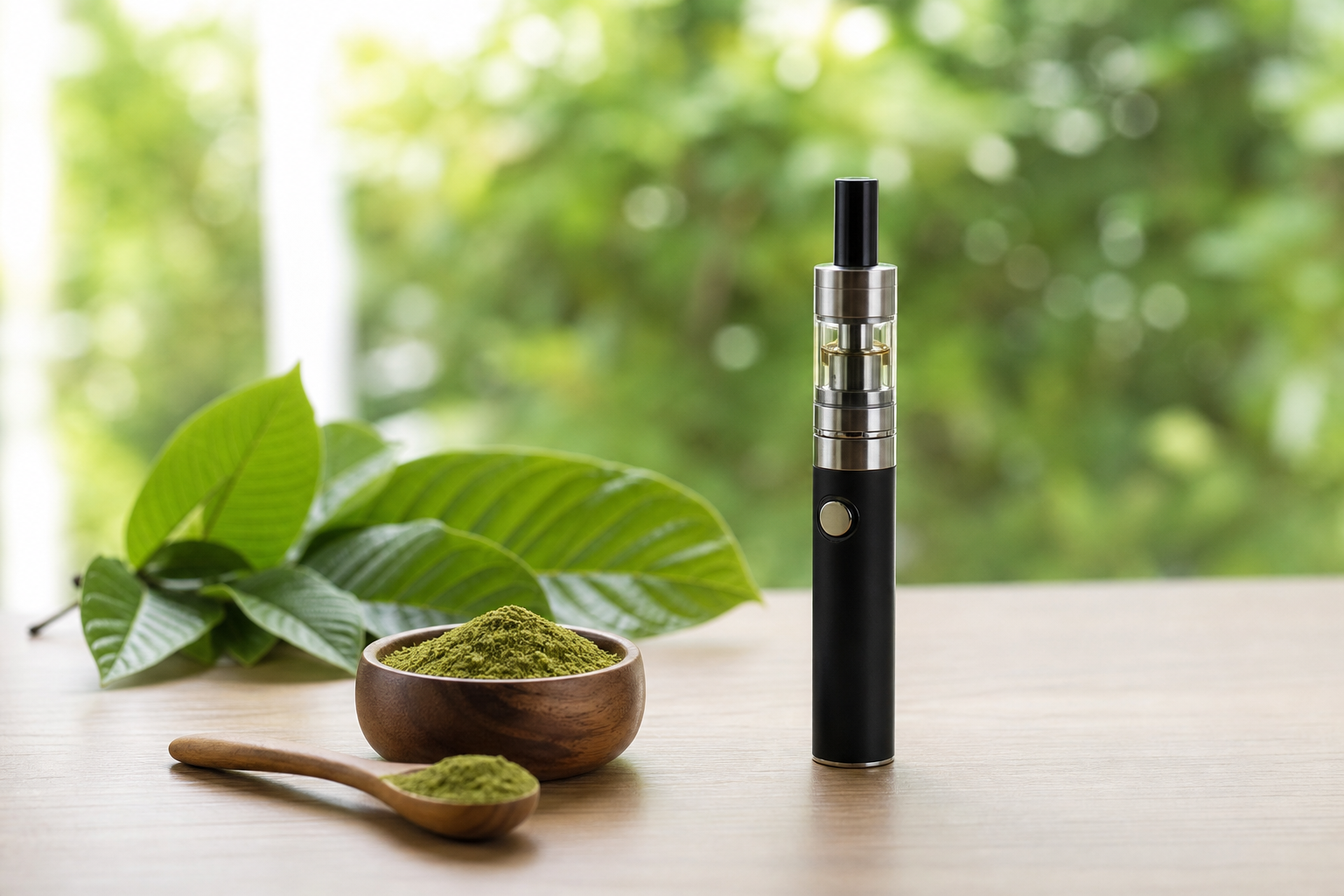
Kratom is most commonly encountered as leaf powder, capsules, tea, extracts, or other oral products. A growing number of products marketed as a kratom vape or for kratom vaping have added a new layer of uncertainty: consumers may assume that putting a botanical ingredient into a vape device makes it comparable to other inhaled products. It does not.
The safety profile of inhaling heated kratom material is not well established. That matters because the route of use can change how a substance enters the body, how quickly effects are felt, and what new compounds or contaminants may be created when a liquid or plant-derived extract is heated.
For anyone weighing whether to try one, the prudent approach is to treat kratom vaping as a distinct and poorly characterized product category—not simply a faster version of traditional kratom.
What makes a kratom vape different?
Traditional kratom products are made from the leaves of Mitragyna speciosa. Their primary active constituents are often described as kratom alkaloids, including mitragynine and 7-hydroxymitragynine. With oral use, these compounds pass through the digestive system and liver before reaching circulation. Effects can be delayed, variable, and influenced by food, product strength, and individual metabolism.
An inhaled product works differently. A vape device heats a liquid, oil, or other formulation into an aerosol that is breathed into the lungs. The formulation may contain much more than a botanical extract: common components can include solvents, flavorings, thinning agents, nicotine, cannabinoids, or other active ingredients.
That creates several important questions:
- Is the listed kratom-derived ingredient actually present, and is its amount disclosed?
- Is the product a true aerosol formulation, or is it simply plant material or an extract unsuited to heating?
- What else is in the cartridge, disposable device, or e-liquid?
- Has the finished product been tested for contaminants and consistency?
- Does heating alter the original compounds or generate potentially irritating byproducts?
Those questions are not minor details. They are central to vape product safety.
Claims about speed or strength deserve caution
Marketing for inhaled products often leans on claims of rapid onset, convenience, or a cleaner experience. Consumers should be cautious with all three.
Inhalation can produce faster effects for some substances, but that does not establish that a given kratom formulation delivers kratom alkaloids effectively or predictably. It also does not establish that a rapid effect is safer. Faster onset can make it harder for a person to judge their response before taking another puff, particularly when labeling is incomplete.
The expected kratom effects of oral products—often described by users as varying with product composition, amount, and individual response—should not be assumed to translate directly to an inhaled product. A cartridge may contain a different extract, a different balance of alkaloids, or no meaningful amount of the compounds implied by its branding.
Be especially skeptical of products that promise a particular mood, energy, pain, relaxation, or opioid-like result. Such claims can overstate what is known and can obscure meaningful health risks, interactions, and quality concerns.
Heating creates its own safety questions
Even a familiar ingredient can behave differently when heated. The temperature of a device, the carrier liquid, coil condition, and the formulation itself can affect what reaches the user’s lungs.
The broader evidence around vaping risks is a reason for restraint, not a reason to presume that a botanical vape is harmless. Inhaling aerosols may expose the lungs to ultrafine particles, chemical byproducts, flavoring compounds, and metals from device components. The precise risk depends on the product and how it is used, but “herbal” is not a safety certification.
An herbal vaporizer designed for dry plant material is also not interchangeable with a cartridge vape. Devices vary in heating method and temperature control. More importantly, there is no basis to assume that dried kratom leaf is appropriate to vaporize. Burning or overheating plant material can produce harsh smoke and unwanted combustion products, while low temperatures may not meaningfully aerosolize the relevant compounds.
Consumers should not attempt to modify devices, mix powders into e-liquids, or use homemade extracts in cartridges. Poor solubility, uneven distribution, unknown additives, and contamination can make do-it-yourself formulations particularly unpredictable.
Labeling and testing are practical decision points
A responsible buyer should view vague labeling as a stop sign. If a product does not clearly identify its ingredients, manufacturer or seller, batch information, and intended use, there is little basis for trusting it.
Third-party laboratory documentation can be useful, but it should be relevant to the actual finished vape product—not merely a test of raw kratom powder. The most meaningful documentation addresses identity and contamination concerns, such as microbial contamination, heavy metals, residual solvents, pesticides, and the presence of undeclared drugs. A report that cannot be linked to the exact batch offers limited reassurance.
Watch for another common problem: products marketed with kratom language that are actually built around nicotine, hemp-derived cannabinoids, synthetic stimulants, or poorly identified “proprietary blends.” Those ingredients can change both the effects and the risk profile. Never assume a product is nicotine-free or cannabinoid-free because its name emphasizes kratom.
Interactions and health considerations still apply
Kratom can have significant effects, and kratom safety is not only a question of purity. It can interact with alcohol, sedatives, opioids, stimulants, and medications. Combining substances can increase impairment and may raise the risk of dangerous side effects.
People with lung or heart conditions, liver concerns, a history of substance-use problems, or sensitivity to stimulants or sedatives should be particularly cautious. Pregnancy and breastfeeding are also situations where avoiding kratom and unregulated vape products is the safer course.
Stop using a product and seek medical help for serious or escalating symptoms such as trouble breathing, chest pain, fainting, severe confusion, seizures, persistent vomiting, signs of an allergic reaction, or unusual sedation. Tell clinicians what was used, including the product label or packaging if available. Accurate information can matter in treatment.
A consumer-first way to assess the category
For many people, the most informed choice will be to avoid kratom vape products until there is clearer evidence on inhalation, formulation standards, and long-term outcomes. If someone is still considering a purchase, a cautious kratom consumer guide starts with refusing to fill gaps in the label with assumptions.
Avoid products that lack a complete ingredient list, make dramatic health claims, conceal the manufacturer, or discourage questions about testing. Do not drive, operate equipment, or combine the product with alcohol or other drugs. Do not share devices, particularly given hygiene and cross-contamination concerns.
It is also worth separating product marketing from reliable information. Kratom news can help consumers track recalls, regulatory developments, and emerging reports of contamination, but a headline or social-media testimonial is not proof that a particular device is safe or effective. When the product category is new and poorly standardized, caution is not alarmism; it is sound consumer judgment.