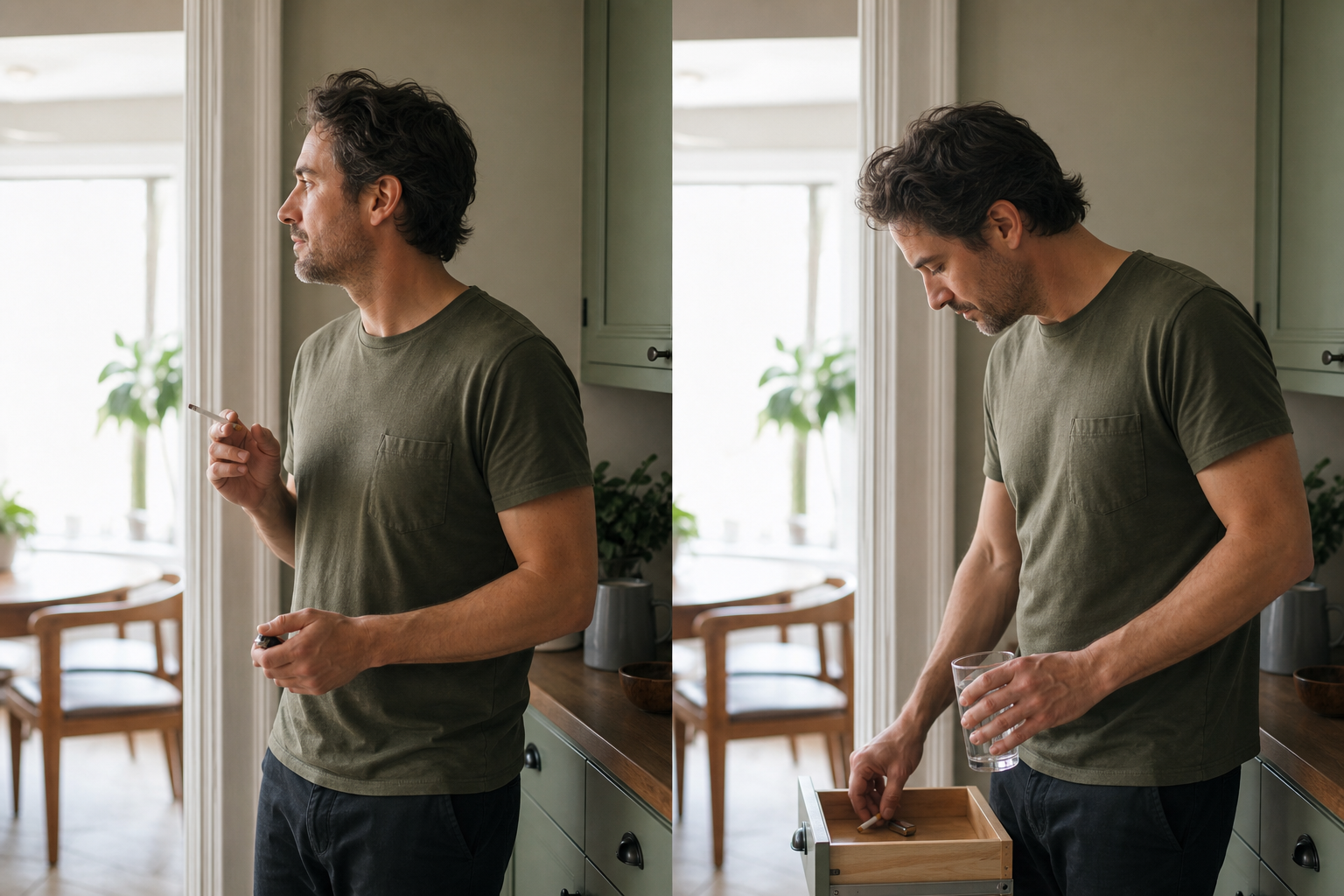
The benefits of quitting smoking and vaping instead depend less on the device itself than on what leaves your routine. Replacing every cigarette with vaping is meaningfully different from smoking and vaping together. Replacing cigarettes with an evidence-based quit aid is different again. And quitting nicotine entirely is a separate goal.
The often-missed question is not simply, “Is vaping better?” It is: “What is my next realistic move, and does it remove cigarette smoke from my day?” That distinction makes it easier to choose a plan without pretending that any nicotine product is harmless.
What we swapped and why: benefits of quitting smoking and vaping instead
For this comparison, the starting point is an adult who currently smokes cigarettes and wants a practical alternative. The swap is not “smoking for occasional vaping.” It is a complete replacement of combustible cigarettes with either vaping or a regulated nicotine-replacement option, while also building a route toward stopping nicotine if that is the goal.
Cigarettes burn tobacco. That combustion creates smoke and exposes the user, and people nearby, to a broad range of toxic substances. Vapes heat liquid into an aerosol rather than burning tobacco. That difference is why a complete switch away from cigarettes can reduce exposure to many of the harmful chemicals associated with smoke.
It does not make vaping risk-free. Vape aerosol can contain substances that irritate the airways, and nicotine can maintain dependence. Product quality, device use, and individual health all matter. Someone who has never smoked does not gain a health benefit by taking up vaping.
The point of an alternative is to help a smoker stop inhaling cigarette smoke. If vaping keeps cigarettes in the picture, the main advantage is weakened. This is where many plans stall: a person vapes in places where they cannot smoke, then continues smoking at other times. It can feel like a reduction, but it may preserve both the nicotine habit and the smoking cues.
The comparison that matters: replacement versus addition
| Decision path | What leaves the routine | What remains | Likely practical effect |
|---|---|---|---|
| Keep smoking | Nothing | Cigarette smoke and nicotine dependence | Continued exposure to the harms of combustible tobacco |
| Smoke and vape together | Some cigarettes may be displaced | Cigarette smoke, vaping exposure, and nicotine dependence | Limited benefit if smoking continues regularly; routines can become more complicated |
| Switch completely from cigarettes to vaping | Cigarette smoke | Vaping exposure and often nicotine dependence | Removes tobacco combustion, but does not eliminate health risk or dependence |
| Use nicotine replacement or prescribed cessation support and stop smoking | Cigarette smoke | Temporary nicotine use may remain | Can separate nicotine cravings from the act of smoking and support a planned quit attempt |
| Quit smoking and nicotine | Cigarette smoke and nicotine | Withdrawal and learned routines need managing | Avoids ongoing smoke exposure and nicotine dependence, with support often making the process more manageable |
A controlled personal swap means changing the main source of nicotine while observing what happens to smoking urges, routines, breathing comfort, sleep, mood, and dependence. Keep the goal narrow: no cigarette smoking. Avoid treating the alternative as an extra product to use whenever convenient.
If you choose vaping as a bridge away from cigarettes, select a plan before starting. Decide what will count as a cigarette-free day, identify the situations most tied to smoking, and consider how you will reduce or stop vaping later. A bridge works best when it has somewhere to go.
What changed
The clearest change after eliminating cigarettes is the removal of tobacco smoke. People may notice changes in taste, smell, cough, breathlessness, stamina, or the stale smell on clothes and living spaces. The experience varies. Some people feel improvements quickly, while others notice discomfort first as their body adjusts or as nicotine withdrawal appears.
Withdrawal can be mistaken for proof that quitting is not working. Irritability, restlessness, low mood, poor concentration, stronger appetite, and intense cravings are common when nicotine intake changes. These effects are real, but they are temporary symptoms of dependence and habit disruption rather than a reason to return to smoking.
A person who switches to vaping may avoid some withdrawal if they continue receiving nicotine. That can make cigarettes easier to leave behind, but it also means vaping can become the new automatic response to stress, boredom, driving, breaks, alcohol, or social situations. The health improvement from removing smoke and the challenge of nicotine dependence can exist at the same time.
Will my lungs heal if I vape instead of smoking?
Stopping cigarette smoking gives the lungs a chance to recover from ongoing smoke exposure. Airway irritation and smoking-related respiratory symptoms may improve after cigarettes are removed. How much improvement someone experiences depends on their smoking history, existing lung disease, infections, allergies, and other health factors.
Vaping is not a lung-healing treatment. It can still irritate the respiratory system, and continued vaping means the lungs are not free from inhaled aerosol. For a smoker unable to stop nicotine immediately, a full switch can be a harm-reduction step because it ends cigarette combustion. The better long-term destination for lung health is not smoking, and ideally not inhaling nicotine aerosol either.
Seek clinical advice promptly for persistent chest pain, significant shortness of breath, coughing blood, or a major change in breathing. Anyone with a diagnosed heart or lung condition, or who is pregnant, should discuss the safest quitting options with a qualified clinician rather than relying on a generic switching plan.
Is it healthier to vape instead of smoking?
For an adult who already smokes, completely switching from cigarettes to vaping is generally considered less harmful than continuing to smoke because it removes tobacco combustion. “Less harmful” is not the same as safe, and it should not be read as an invitation for non-smokers to vape.
The key word is completely. Continuing to smoke while vaping leaves ongoing exposure to cigarette smoke. Even a reduced smoking pattern can preserve the behavioural loop that makes quitting hard: reaching for nicotine after meals, with coffee, during conflict, or while drinking.
If the choice is between continuing to smoke and fully replacing cigarettes while working toward nicotine cessation, the complete replacement path is more likely to make a meaningful difference than dual use. If the choice is between starting vaping and not using nicotine at all, not starting is the healthier option.
What happens if you quit smoking but start vaping?
You may find cigarettes less appealing or easier to avoid if vaping manages cravings that would otherwise pull you back to smoking. You may also retain nicotine dependence, learn new vaping cues, and use nicotine more frequently because a vape can be more convenient than a cigarette.
That outcome is not a failure if the immediate objective was to stop smoking. It is a reason to be deliberate about the next step. Monitor whether vaping is replacing specific cigarette moments or spreading into parts of your day that were previously nicotine-free. A useful plan prevents the new habit from quietly becoming larger than the old one.
Choose products from legitimate sources, avoid modifying devices or liquids, and do not use informal or unknown products. If you use a vape to leave cigarettes, keep cigarettes out of reach rather than keeping them as a supposed backup.
Is it easier to quit vaping or smoking cigarettes?
There is no universal answer. Cigarette smoking combines nicotine dependence with powerful sensory and social rituals: lighting up, smoke breaks, hand-to-mouth action, and the immediate end point of a cigarette. Vaping can remove some of those rituals but may create a more frequent pattern because it is easy to take repeated puffs without a natural stopping point.
What matters is the strength of nicotine dependence, the situations linked to use, and whether the person has support. Some smokers find a staged approach manageable: first end cigarettes, then gradually reduce vaping or move to nicotine replacement. Others prefer a planned quit date and complete nicotine cessation. A clinician, pharmacist, quit service, or counsellor can help match the approach to your health and history.
The rule of thumb
If you smoke, the biggest practical health gain comes from getting cigarette smoke out of your life. Do not judge a plan by whether it looks cleaner, costs less, or feels more modern. Judge it by whether it reliably stops smoking rather than sitting beside it.
Use this decision test:
- If you can stop nicotine altogether with support, that avoids both smoking and vaping exposure.
- If you cannot do that yet, use a proven cessation approach that helps you stop cigarettes and gives you a clear next step.
- If vaping is the option you will actually use instead of smoking, make the switch complete rather than combining both products.
- If you are already vaping and do not smoke, do not add cigarettes; focus on reducing nicotine dependence if you want to quit.
- If you do not smoke or vape, do not start either.
Make the experiment concrete. Remove cigarettes, ashtrays, lighters, and the routines that make smoking automatic. Prepare alternatives for predictable triggers: a walk, water, a message to a supportive person, a brief breathing exercise, or a snack if hunger is part of the urge. Cravings rise and pass; they do not require action.
Finally, do not turn a lapse into a return to full-time smoking. Treat it as information. Ask what situation led to it, adjust the plan, and resume the smoke-free choice at the next opportunity. The meaningful difference is not perfection on the first attempt. It is reducing and ultimately ending exposure to cigarette smoke while building a plan that you can sustain.