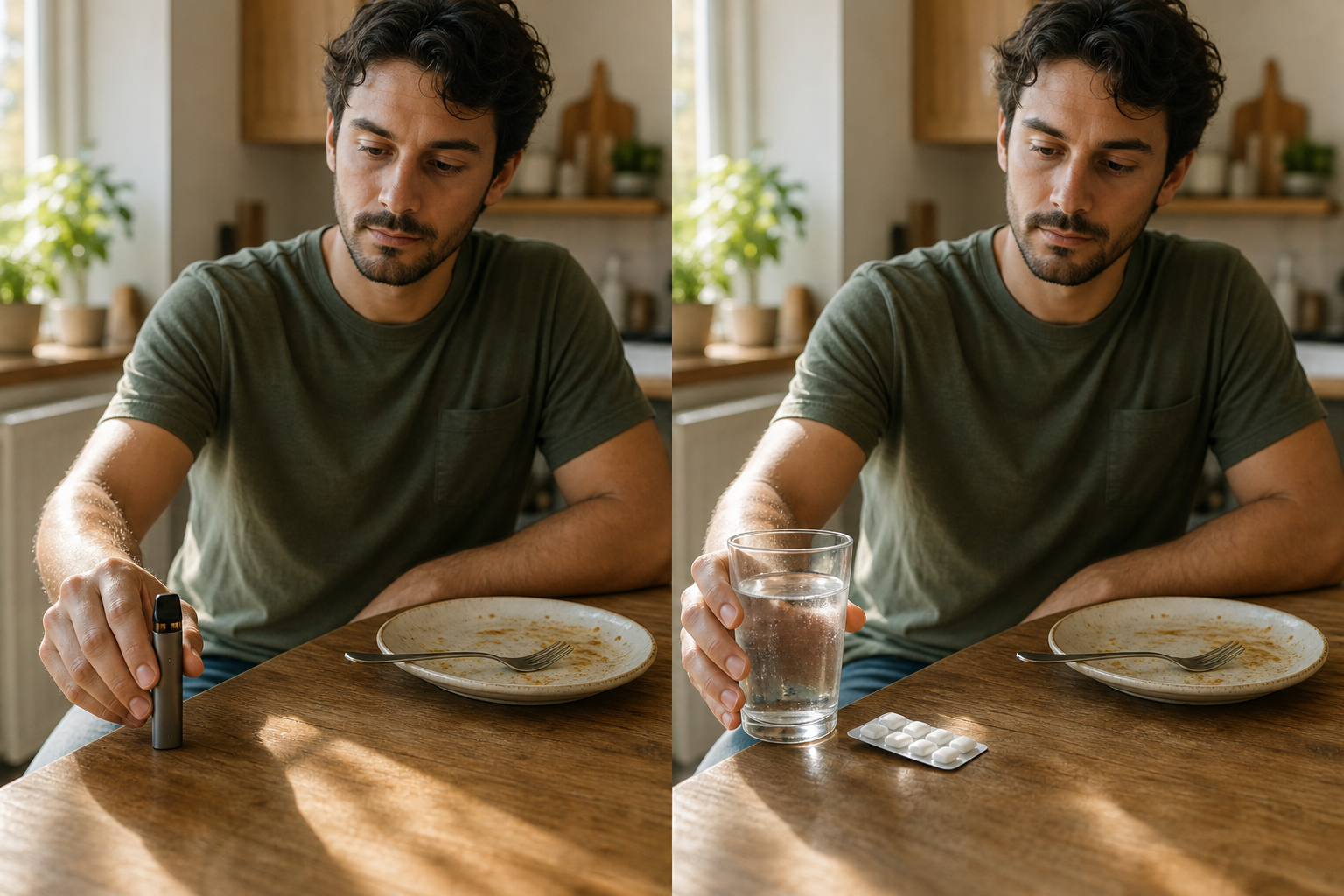
What we swapped and why: vape alternative no nicotine
A vape alternative no nicotine can mean two very different things: keeping the inhale-and-exhale ritual without nicotine, or replacing the ritual itself with something that does not involve inhaling anything. That distinction matters more than flavor, vapor volume, or device design.
The useful comparison is not between brands. It is between a nicotine-free vaping device and a small set of non-inhaled replacements used at the moments vaping normally happens: while driving, after meals, during a work break, or when stress hits.
This is the angle often missed in product comparisons. A nicotine-free device may remove nicotine exposure, but it can also keep the familiar cue loop intact: reaching for a device, bringing it to the mouth, inhaling, and taking a pause. For some people, that is a helpful bridge. For others, it is exactly what makes the habit harder to leave behind.
What is in a non nicotine vape?
Nicotine-free vaping products commonly use a liquid or other material designed to create an inhalable aerosol. Labels may list flavorings, carrier ingredients, and other additives. A product described as nicotine-free should not be assumed to be ingredient-free, tobacco-free, or risk-free.
Check the package carefully rather than relying on front-label language. Look for a clear ingredient list, manufacturer information, and instructions. Avoid products with vague contents, misleading health claims, or no meaningful labeling.
A flavored-air or water-style device may be presented differently from a conventional vape, but the practical question remains the same: what is being heated or inhaled, and are you comfortable making that part of your routine?
The side-by-side swap
| Decision point | Nicotine-free vape device | Non-inhaled replacement kit |
|---|---|---|
| Main benefit | Preserves a familiar hand-to-mouth pause | Breaks the inhaling routine while meeting a specific need |
| Nicotine | Intended to contain none | Contains none when chosen that way |
| Ritual similarity | High | Lower, but can be adapted to the trigger |
| What it may help with | Missing the motion, flavor, or social pause | Dry mouth, restless hands, oral fixation, stress pauses, boredom |
| Main trade-off | May keep vaping cues active | Can feel less satisfying at first because it is not a direct copy |
| Ingredient concern | You are still inhaling an aerosol or vapor | Depends on the item, but does not require inhalation |
| Best fit | A deliberate temporary step away from nicotine | A person whose goal is to move away from vaping behavior itself |
The comparison works best when the situation stays consistent. If the strongest urge comes after eating, test each option after meals for a short stretch. If driving is the difficult moment, keep the replacement within reach in the car. Changing several variables at once makes it difficult to tell what actually helped.
What changed
The clearest difference is usually not whether a craving disappears immediately. It is whether the chosen substitute moves you toward your actual goal.
If nicotine is the main problem, a nicotine-free device may remove the drug while leaving the behavior familiar. If the inhale itself has become the problem, a non-inhaled option gives the hands, mouth, and attention something else to do without rehearsing the same action.
That does not make the non-inhaled route automatically easy. A direct substitute can feel unsatisfying precisely because it does not recreate the old ritual. That discomfort is often useful information: it can reveal whether the pull is nicotine withdrawal, a learned cue, stress, boredom, or a mix of all of them.
Is non nicotine vape harmful?
No-nicotine does not mean harmless. Removing nicotine eliminates nicotine exposure, but inhaling flavorings or other aerosolized ingredients can still irritate the mouth, throat, or airways. The long-term effects of repeatedly inhaling many vaping ingredients are not something to dismiss simply because nicotine is absent.
Someone who does not already vape or smoke has no health reason to begin using an inhaled product. Someone trying to stop nicotine may decide that a nicotine-free vape is an acceptable short-term transition, but it is worth treating that as a deliberate plan rather than an open-ended new habit.
Stop using a product and seek medical advice promptly if vaping is followed by chest discomfort, shortness of breath, persistent coughing, dizziness, or a reaction that feels unusual or severe. For ongoing respiratory symptoms, a clinician is a better guide than product marketing or online anecdotes.
What to do instead of vaping nicotine?
Match the substitute to the trigger instead of asking one object to solve every urge.
- For a dry-mouth or oral urge: keep water, unsweetened gum, mints, or a crunchy snack available.
- For restless hands: use a pen, small fidget item, straw, or cup with a lid and straw.
- For a stress break: step outside, slow your breathing, stretch, or take a brief walk without bringing a device.
- For driving: prepare a drink, gum, and something safe for your hands before leaving.
- For social situations: tell a trusted person what you are changing and plan a reason to step away if the urge spikes.
- For a strong nicotine craving: consider speaking with a clinician or pharmacist about established quit support and whether medication or nicotine-replacement approaches suit your situation.
The goal is not to create a perfect replica of vaping. It is to make the next choice easy enough that you can get through the trigger without automatically reaching for a device.
What is vaper’s tongue?
“Vaper’s tongue” is a casual term for when flavors seem muted or difficult to notice while vaping. It may be related to repeated exposure to the same flavor, dry mouth, congestion, changes in taste or smell, or irritation. It is not a reliable measure of whether a product is safe.
Switching flavors may mask the issue temporarily, but it can also encourage more frequent use. Hydration, a break from vaping, and attention to persistent taste or smell changes are more useful responses. If changes do not resolve or come with other symptoms, seek medical guidance.
How many puffs of vape is equal to one cigarette?
There is no dependable puff-for-puff conversion. Devices vary in liquid delivery, power, airflow, nicotine concentration, and how a person inhales. Cigarettes also vary, and people do not use either product in identical ways.
For a nicotine-free product, the more relevant point is that there is no nicotine dose to compare. The behavior can still feel compelling because the cue pattern remains. Counting puffs can become another way of focusing on the ritual rather than changing it.
Can lungs heal after 7 years of vaping?
Bodies can recover in different ways after exposure stops, but no one can promise a particular outcome or timeline. Recovery depends on factors such as symptoms, prior smoking, frequency of vaping, existing health conditions, and what was inhaled.
The practical step is to stop or reduce the exposure you are concerned about and get a clinical assessment if you have continuing cough, wheeze, breathlessness, chest symptoms, reduced exercise tolerance, or worry about your lung health. A clinician can assess the person in front of them rather than guessing from years of use alone.
The rule of thumb
Choose the least inhalation-dependent option that still gets you through the trigger.
A nicotine-free vape can make sense as a tightly defined transition when the immediate alternative is returning to nicotine vaping or smoking. Give it a purpose: identify the situations where it is allowed, decide what will replace it next, and notice whether use is shrinking rather than simply continuing without nicotine.
Choose a non-inhaled substitute when your priority is ending the vaping routine, reducing uncertainty about inhaled ingredients, or avoiding a device that keeps calling for your attention. Build a small kit around real-life cues instead of relying on willpower at the hardest moment.
Use this quick decision check before buying anything:
- Is the goal to stop nicotine, stop vaping, or both?
- Does the product help only in the situations where cravings are strongest?
- Does it have clear ingredients and credible labeling?
- Is it making the habit less central to the day, or giving the habit a new form?
- Could a drink, gum, movement, support, or clinical quit aid meet the same need with less inhalation?
If a nicotine-free device keeps you from going back to nicotine, it may be a useful stepping stone. If it turns every pause into another reason to inhale from a device, a more meaningful swap is likely the better choice.