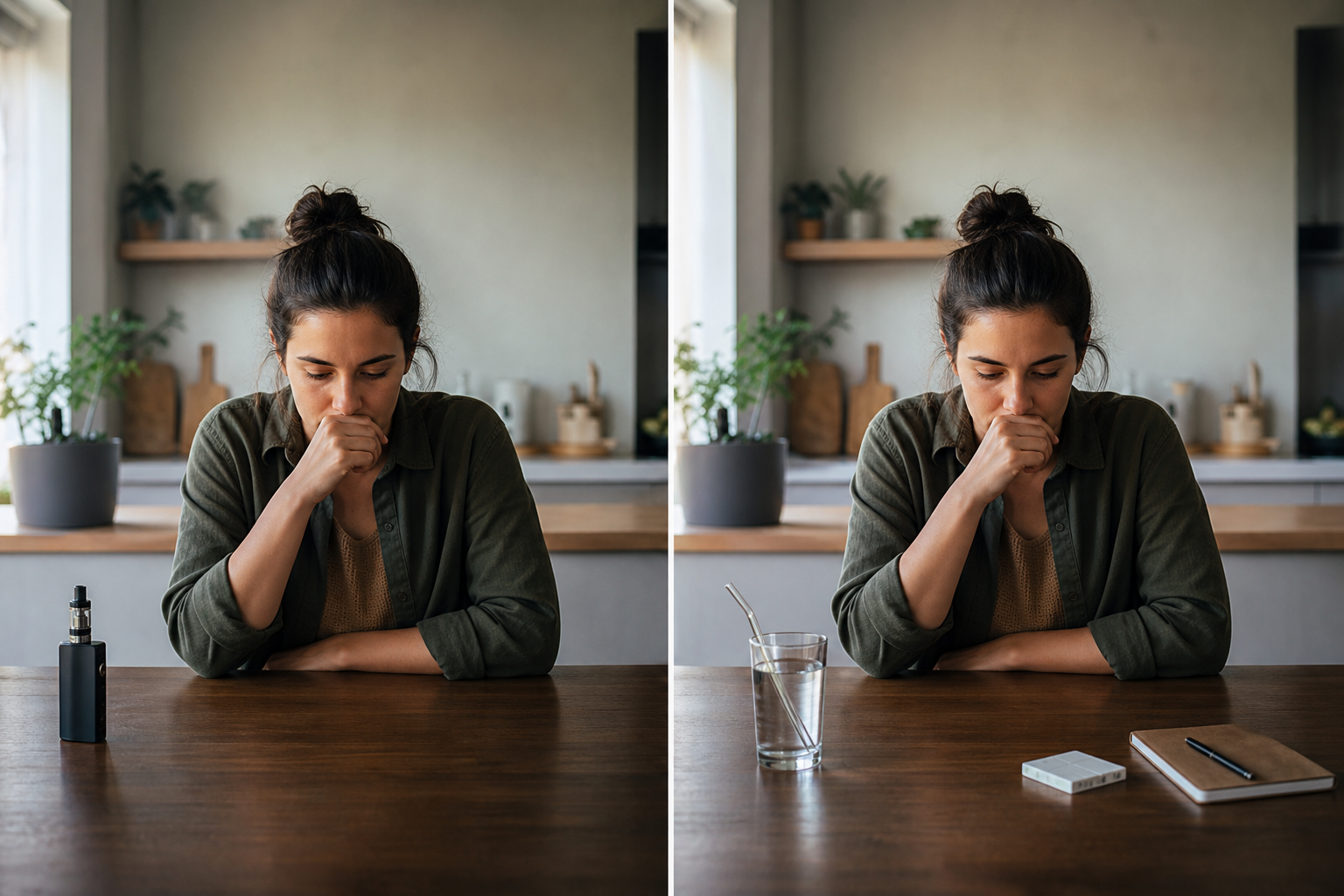
People looking for natural vape alternatives for nicotine often focus on the ingredient list. That is understandable, but it can distract from the decision that matters most: whether you are replacing nicotine, replacing the inhale-and-exhale ritual, or replacing a situation that has become linked to vaping.
A plant-derived or nicotine-free product is not automatically a safer product. The useful comparison is not “natural versus artificial.” It is inhaled versus non-inhaled, nicotine-containing versus nicotine-free, and temporary support versus a habit that keeps renewing itself.
What we swapped and why
The cleanest personal experiment changes a single major factor: stop using nicotine while preserving enough of the routine to see what is actually driving the urge.
For many people, vaping is a bundle of needs rather than a single need. There may be physical nicotine withdrawal, a hand-to-mouth action, a pause during stress, a flavor cue, or a familiar activity attached to driving, socializing, or finishing a meal. Trying to solve all of that with a new herbal vape can leave the real trigger untouched.
A more informative swap is a nicotine vape against a non-inhaled routine that serves the same moment. That might mean cold water through a straw, regular gum, a flavored toothpick, a small snack, a brief walk, slow breathing, or something to hold in the hand. The point is not to find a perfect replica. It is to learn whether the inhale is necessary or whether the pause is doing most of the work.
Here is how the options compare when the goal is to move away from nicotine rather than simply buy a differently labeled device.
| Choice | What it can replace | What it does not solve | Main caution |
|---|---|---|---|
| Nicotine vape | Nicotine delivery, hand-to-mouth routine, flavor, throat sensation | Dependence on nicotine | It can keep both chemical dependence and vaping cues in place |
| Nicotine-free vape | Hand-to-mouth action, flavor, visible vapor, inhale ritual | Nicotine withdrawal and many situational triggers | Nicotine-free does not mean harmless to inhale, and it may prolong the vaping habit |
| Herbal or botanical vape | Flavor and the idea of a “natural” product | Withdrawal, stress patterns, and learned cues | Plant material, extracts, and oils are not automatically appropriate or safe for heating and inhaling |
| Non-inhaled oral or sensory substitute | Hand-to-mouth action, flavor, oral stimulation, a pause | Some strong nicotine withdrawal | It may feel less satisfying at first because it does not copy the vapor ritual |
| Clinician-guided quit support | Nicotine withdrawal and a plan for triggers | The need to build replacement routines | It works best when paired with practical changes to everyday cues |
The important distinction is route of exposure. A product can be natural, familiar, or food-grade and still be a poor candidate for the lungs when heated. “Safe to eat” and “safe to inhale” are different questions.
What can I put in a vape instead of nicotine?
The safest answer is not to improvise. Do not add essential oils, kitchen extracts, homemade herb blends, alcohol, supplements, or other substances to a vape device. Heating changes substances, and products not made for inhalation may irritate airways or create risks that are difficult to predict.
If someone chooses to use a nicotine-free vape liquid, it should be a product specifically made for that device and used according to its directions. That still does not make vaping risk-free. It only removes nicotine from the equation.
If the aim is to avoid both nicotine and inhalation, choose a non-vape replacement. A drink, gum, mint, toothpick, or paced breathing has a major practical advantage: it can occupy the same break without adding aerosol exposure.
The “natural” label is not the deciding factor
Natural can describe where an ingredient came from. It does not tell you how that ingredient behaves under heat, how much reaches the lungs, or whether a device delivers it consistently.
This is especially relevant for herbal vaping products marketed as calming, cleansing, or supportive. A promise of relaxation may be appealing when stress is a vaping trigger, but it does not establish that inhaling the product is a sound substitute. If stress is the problem, use a stress tool directly rather than turning the search for relief into a new inhalation habit.
What changed: natural vape alternatives for nicotine
The side-by-side result to look for is not simply whether a substitute feels identical. It is whether it reduces the urge enough to get through the moment without reinforcing the behavior you want to leave behind.
A non-inhaled substitute often feels less dramatic than a vape. That can be a strength. It interrupts the learned chain of reaching, inhaling, and getting immediate sensory feedback. It may not satisfy every craving at once, but it gives you information about what needs attention.
What kills nicotine craving?
Nothing reliably erases every craving on command. Cravings tend to be easier to manage when they are treated as a short-lived event rather than a command to act.
When an urge hits, identify its likely source before choosing a response:
- Physical withdrawal: Consider discussing evidence-based quit medications or nicotine replacement with a pharmacist or clinician. These options are designed to address nicotine dependence more directly than herbal vaping products.
- Oral or hand habit: Use gum, mints, a straw, a toothpick, or a small object to handle.
- Stress or agitation: Step away from the cue, drink water, stretch, breathe slowly, or take a short walk.
- Automatic routine: Change the location or sequence attached to vaping. If vaping follows coffee, move the coffee routine, use a different cup, or add a task immediately afterward.
- Social pressure: Prepare a simple response and bring a substitute before going into the situation.
The replacement should match the trigger. A mint may help with an oral urge but do little for withdrawal. A clinician-guided nicotine treatment may reduce withdrawal but still leave a person reaching for a device during a stressful commute. Combining support for both parts is often more useful than searching for a single “natural” solution.
What is the healthiest alternative to vaping?
For someone who does not use nicotine, the healthiest choice is not to start vaping or inhaling herbal products. For someone who currently vapes, the healthiest direction is generally toward no nicotine and no inhaled aerosol, with a plan that makes that change realistic.
The best immediate alternative is therefore the least risky option that you can actually use when a craving arrives. Non-inhaled supports are usually the clearest fit for people who want to break the vape ritual. Professional quit support may be especially useful if cravings feel difficult to control, if vaping starts soon after waking, or if previous attempts have felt overwhelming.
A nicotine-free vape can be a transitional tool for some adults, particularly when the ritual is the sticking point. But it should be treated as a bridge with an exit plan, not as proof that a natural or nicotine-free product is healthy. Keep the goal visible: less nicotine, less inhalation, and fewer moments that require a device.
Will my lungs heal if I vape instead of smoking?
Switching completely away from combustible cigarettes avoids exposure to smoke from burning tobacco. That is a meaningful change from continuing to smoke. It does not mean vaping is harmless, and it does not guarantee a particular healing outcome for any individual.
The lungs are generally better served by moving away from smoke and then away from inhaled aerosols as well. Symptoms such as persistent cough, wheezing, chest discomfort, breathlessness, or coughing up blood deserve prompt medical attention rather than an attempt to self-treat with a different vape product.
If you both smoke and vape, avoid treating vaping as permission to continue smoking. The benefit of leaving cigarettes behind depends on actually leaving them behind. A clinician can help tailor a quit plan around your current nicotine use and health history.
The rule of thumb
Choose the substitute that addresses the real job vaping is doing, while adding the least new risk.
If you need help with nicotine withdrawal, get support aimed at nicotine dependence rather than relying on an herbal vape. If you need something for your hands and mouth, use a non-inhaled object or flavor. If you need a stress break, build a brief repeatable break that does not involve a device. If you are using vaping to avoid cigarettes, protect the progress by making a plan to move beyond both smoking and vaping.
Avoid equating “natural” with lung-safe. Avoid putting unapproved substances into a vape. Avoid making a replacement so similar to your old routine that it becomes difficult to leave.
A practical rule is simple: use inhalation only less, not differently. The more your alternative removes nicotine, aerosol, and automatic cue-driven use, the more likely it is to move you toward the outcome you actually want.