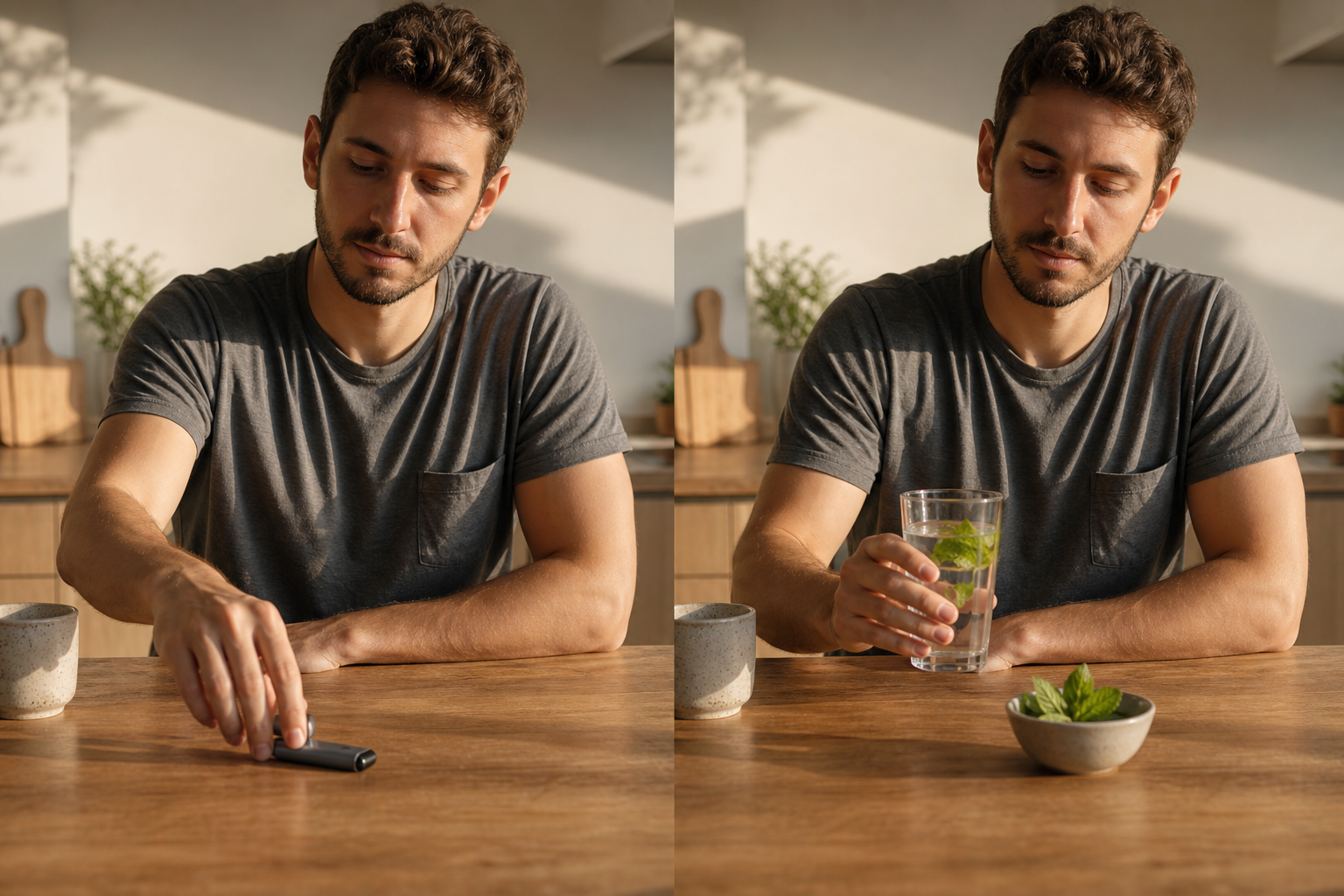
Natural vape alternatives disposable products are often sold as a cleaner-feeling replacement for a standard disposable vape. That description can hide the decision that matters most: are you trying to stop nicotine, stop inhaling aerosol, interrupt an automatic hand-to-mouth routine, or reduce waste from disposables?
Those goals call for different substitutes. The overlooked issue is that a product can feel more natural because of its flavoring or plant-based branding while still keeping the same inhale-and-reach habit in place. A useful swap tests the part of vaping that is actually hard for you to give up.
What we swapped and why: natural vape alternatives disposable
For a practical comparison, treat a conventional nicotine disposable as the baseline and compare it with a nicotine-free disposable marketed as botanical, flavored-air, or natural. This is not a test of which product is “healthy.” There is no inhaled consumer product that becomes risk-free because its ingredients sound natural.
It is a test of what changes when nicotine is removed but the device, draw, flavor, and hand-to-mouth motion remain familiar.
That distinction matters because a nicotine-free device may help someone who primarily misses the ritual. It is less likely to fully address nicotine withdrawal for someone whose body has become dependent on nicotine. In that situation, persistent cravings, irritability, trouble concentrating, or strong urges to vape are useful information—not a personal failure and not proof that more flavored vapor is needed.
Set up a fair swap
Keep the situation consistent. Use the alternative only in the moments when you would normally reach for the nicotine vape: a work break, a commute, after a meal, or during a stressful pause. Notice what happens before, during, and after the urge.
Look for these differences:
- Does the urge fade after the sensory ritual, or does it remain intense?
- Are you seeking the device for flavor, something to do with your hands, a break in routine, or nicotine?
- Does the alternative lead to less automatic use, or does it make inhaling feel just as habitual?
- Do you experience throat irritation, coughing, chest discomfort, headache, nausea, or a reaction to fragrance or flavor? Stop using it if you do.
- Does the product clearly disclose whether it contains nicotine and what is in the liquid or air pathway?
A label that says natural is not a complete ingredient or safety explanation. Botanical extracts, flavor compounds, vitamins, and essential-oil-style ingredients are not automatically appropriate to inhale. A product should not make disease-treatment or wellness promises that its label cannot support.
What the comparison can and cannot show
A nicotine-free disposable can demonstrate whether the physical ritual is a major driver of use. It cannot prove that inhalation is harmless, and it does not settle whether you need help managing nicotine dependence.
If the goal is to stop vaping rather than only stop nicotine, an inhaled replacement may prolong the cue-response loop: stress, reach, inhale, brief relief. Non-inhaled options make that loop easier to see because they separate a craving from the act of drawing on a device.
What changed
The clearest change in a nicotine-free swap is the removal of nicotine exposure. For some people, that is a meaningful first move. For others, the familiar device preserves so much of the old routine that it becomes a lateral move rather than an exit.
| Decision point | Nicotine disposable vape | Nicotine-free disposable marketed as natural or botanical | What to take from it |
|---|---|---|---|
| Nicotine | Contains nicotine when labeled as such | May contain no nicotine, but verify the label | Nicotine-free can remove nicotine exposure; it does not automatically remove inhalation concerns. |
| Habit cues | Keeps the device, draw, flavor, and break ritual | Usually keeps many of the same cues | Useful for testing whether the ritual is driving use, but it may also maintain the ritual. |
| Cravings | May temporarily satisfy nicotine dependence | May satisfy a sensory urge but not nicotine withdrawal | A craving that persists points toward a nicotine need or another unmet trigger. |
| Ingredient claims | Often centered on flavor and device features | May emphasize plants, vitamins, or “natural” ingredients | Marketing language is not a safety finding. Read the full label. |
| Lung exposure | Involves inhaling aerosol | Involves inhaling aerosol or flavored air, depending on design | Less nicotine is not the same as no respiratory risk. |
| Disposable waste | Device is discarded after use | Device is still discarded after use | A natural positioning does not solve the disposal issue. |
| Best role | Maintains nicotine delivery and the ritual | Can be a temporary bridge for someone focused on nicotine removal | It is a tool, not a default answer for every goal. |
What is the healthiest vape alternative?
The healthiest alternative to vaping is not inhaling anything. If you want a replacement for the pause, flavor, oral fixation, or hand-to-mouth action, choose an option that does not create aerosol for your lungs.
Depending on the trigger, that could mean a cold drink, gum, a mint, a straw, a toothpick, a small object to fidget with, a walk around the block, paced breathing, or a brief change of setting. None needs to imitate a vape perfectly to be useful. In fact, a substitute that breaks the exact reach-and-inhale pattern may make it easier to build a different response.
If nicotine dependence is part of the picture, talk with a qualified healthcare professional or a tobacco-cessation service about evidence-based support. That route addresses nicotine directly rather than relying on a product that looks and feels like a vape.
What is the healthiest disposable vape?
There is no disposable vape that can be described as healthy. If choosing between products, nicotine-free may be preferable for the specific goal of avoiding nicotine, but that does not turn a disposable inhalation product into a health product.
Be particularly cautious with vague claims such as “vitamin-infused,” “wellness,” “detox,” or “plant-powered.” Those phrases describe marketing themes, not a guarantee of lung safety. Avoid products with unclear ingredient lists, unclear nicotine status, or claims that they treat anxiety, improve sleep, or repair health.
Is there a natural healthy vape?
Natural and healthy are not interchangeable. Plants can contain potent chemicals, and heating or aerosolizing an ingredient can change how it reaches the body. Fragrance that is pleasant in a room is not automatically suitable for the lungs.
A more useful question is: “What exposure am I trying to reduce?” If the answer is nicotine, a verified nicotine-free option may reduce that exposure. If the answer is inhalation, choose a non-inhaled substitute. If the answer is disposables, select a reusable or entirely device-free approach rather than replacing one throwaway product with another.
Can lungs heal after 7 years of vaping?
People can experience improvement after they stop vaping, but the course varies. It depends on prior use, current symptoms, other exposures, and underlying health conditions. Stopping further exposure is the step within your control.
Do not wait out symptoms that feel serious or unusual. Ongoing shortness of breath, chest pain, coughing that does not settle, wheezing, or coughing up blood warrants prompt medical attention. A clinician can assess symptoms and offer individualized guidance without assuming every breathing change has the same cause.
The rule of thumb
Choose the least vape-like substitute that still addresses your real trigger.
If you are trying to remove nicotine but still need a familiar transition, a clearly labeled nicotine-free device may serve as a short-term bridge. Set a clear reason for using it and pay attention to whether it reduces use or simply changes the label on the same habit.
If you are trying to protect your lungs or stop vaping altogether, skip inhaled alternatives and replace the moment instead: a drink, mint, gum, movement, a breathing pause, or support for nicotine cravings. The option that makes the biggest difference is usually not the one with the most natural-sounding ingredients. It is the one that removes the exposure and routine you actually want to leave behind.
Before buying any alternative, use a simple screen:
- Confirm the nicotine status rather than relying on front-label wording.
- Read the ingredient information and avoid products that do not disclose it clearly.
- Treat health and therapeutic claims with caution.
- Stop if it causes discomfort or breathing symptoms.
- Decide whether you want a temporary bridge or a route away from inhaling products altogether.
That last choice keeps a “natural” disposable from becoming an unexamined replacement for the same old pattern.