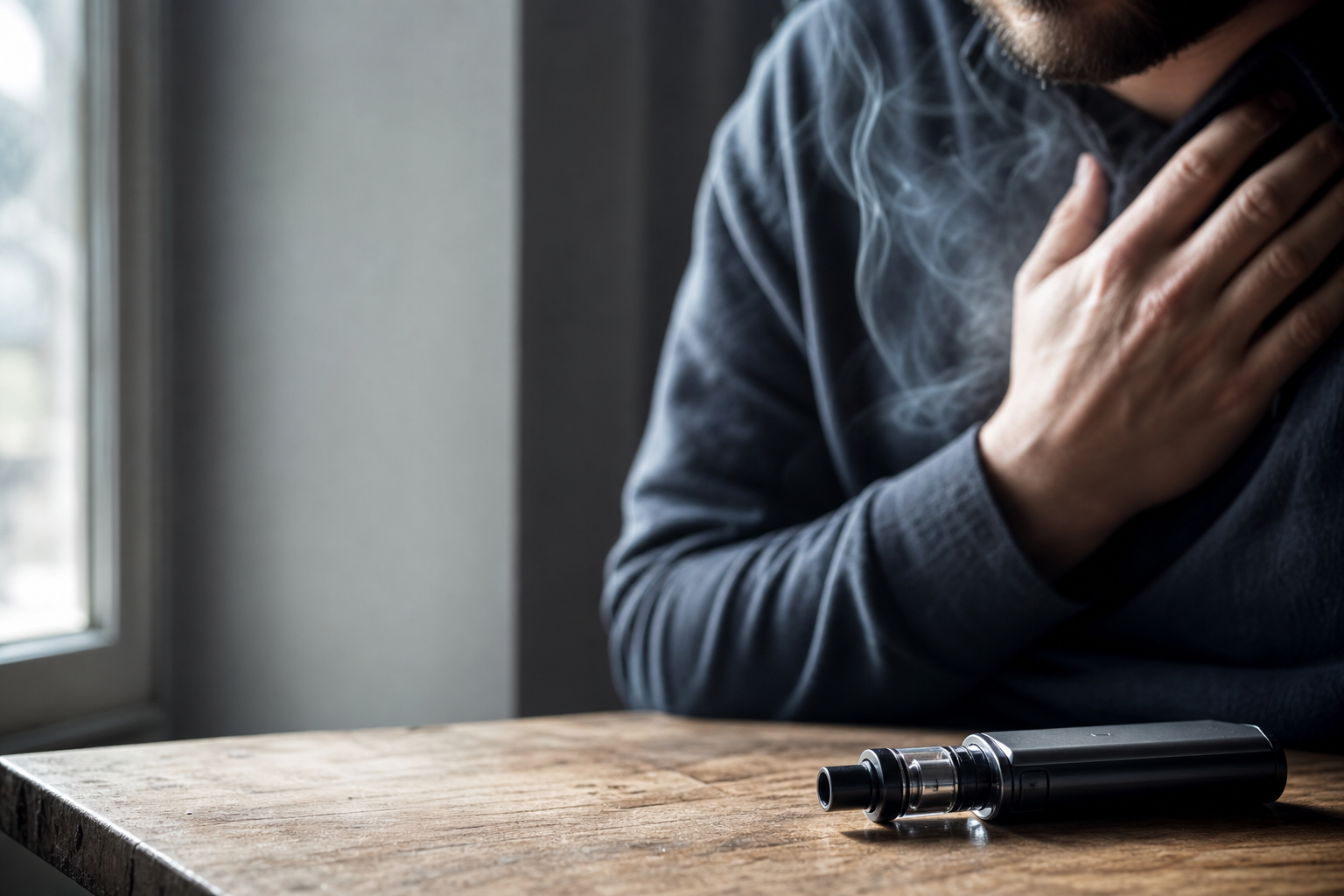
The symptom: can vaping cause lung cancer?
You want a clear answer to can vaping cause lung cancer so you can decide whether to quit, cut back, switch products, or stop worrying. The frustrating symptom is that the answer often sounds vague: vaping is not harmless, but it also has not existed long enough for every long-term outcome to be mapped with the certainty people expect.
That uncertainty is not a reason to treat vaping as safe. It is a reason to make a decision based on what is already known: inhaling heated aerosol can expose the lungs to substances that may irritate tissue, promote inflammation, and damage cells. Some vape products can also contain chemicals or contaminants of concern. Cancer generally develops over a long period, so the absence of a simple personal prediction does not remove the risk.
The angle often missed is that the urgent decision is not whether anyone can promise vaping will cause cancer in your specific case. It is whether continuing an avoidable lung exposure makes sense when you already have a lower-exposure option: stopping.
Does vape damage your lungs?
It can. Vaping may cause throat irritation, coughing, chest discomfort, shortness of breath, wheezing, and worsened breathing symptoms in some people. The aerosol is not simply harmless water vapor. Even if symptoms are absent, that does not prove the lungs are unaffected.
Has anyone ever got cancer from vaping?
A single person’s cancer diagnosis cannot usually establish one cause. Lung cancer has multiple possible contributors, including past smoking, secondhand smoke exposure, occupational exposures, family history, and other health factors. The more useful question is whether vaping can add cancer-related risk. Based on the substances that can be present in aerosol and the evidence of biological harm, it is reasonable to treat the risk as real rather than wait for a definitive individual case story.
Causes, most likely first
The question feels impossible to resolve when several different issues are bundled together. These are the most likely reasons a person cannot get a useful answer or make a workable plan.
-
You are looking for a guarantee rather than a risk decision. No clinician, article, or product label can tell you precisely whether one person will develop lung cancer. A lack of certainty can become an excuse to continue.
-
You are comparing vaping only with cigarette smoking. Cigarettes create severe health risks, but “possibly less harmful than smoking” does not mean harmless. For someone who does not smoke, beginning or continuing to vape adds exposure without the benefit of replacing cigarettes.
-
You use both cigarettes and vapes. Dual use can preserve nicotine dependence and make total inhaled exposure harder to judge. It can also obscure whether symptoms are linked to smoking, vaping, or both.
-
You assume nicotine is the only issue. Nicotine is addictive and can keep the habit going, but the cancer concern is broader. Heating liquid, flavoring ingredients, particles, and device components can change what reaches the lungs.
-
You trust a familiar brand, flavor, or device as proof of safety. Product appearance, flavor, and marketing do not reveal everything in the aerosol. Informal or altered products add further uncertainty because their ingredients and handling may be unreliable.
-
You are treating symptoms as proof of cancer—or dismissing them because they are not cancer. Cough, chest tightness, fatigue, or breathlessness have many causes. They should not be self-diagnosed, and they should not be ignored simply because lung cancer is not the most likely explanation.
-
You expect your lungs to reset immediately after stopping. Healing can begin after exposure stops, but recovery is not a switch that can be flipped on demand. How someone feels afterward depends on prior smoking, duration and intensity of use, underlying lung conditions, infections, and other factors.
What do years of vaping do to your lungs?
There is no safe timeline that tells you when harm begins or when cancer becomes inevitable. Repeated exposure can maintain airway irritation and inflammation, while long-term cancer outcomes remain difficult to measure fully because vaping is relatively new compared with cigarettes.
The practical takeaway is not to wait for a particular duration. If you vape now, stopping sooner reduces future exposure compared with continuing.
How to fix each one
Replace the demand for certainty with a safer decision rule
If your goal is to protect lung health, use a straightforward rule: do not inhale products you do not need. You do not have to prove that vaping will cause lung cancer in your case before deciding that the risk is not worth accepting.
If you do not smoke cigarettes, the clearest fix is to stop vaping rather than search for a “safe” vape setup.
If vaping replaced cigarettes, avoid sliding into dual use
For an adult who currently smokes cigarettes, the priority is moving away from combustible tobacco completely rather than adding vaping on top of it. Consider discussing a quit plan with a healthcare professional. Approved cessation support, behavioral counseling, and medication may help address nicotine dependence without keeping an aerosol habit in place.
Do not interpret this as a reason to start vaping if you do not smoke. The appropriate path differs depending on whether you are trying to leave cigarettes behind or are already nicotine-free.
Separate nicotine dependence from lung-risk decisions
A strong craving, irritability, restlessness, or repeated return to vaping may signal nicotine dependence rather than a personal failure. Identify the situations that trigger use: driving, alcohol, work breaks, boredom, stress, social settings, or waking up.
Then make the replacement specific:
- Keep water, gum, or another non-inhaled substitute available for habitual hand-to-mouth moments.
- Change the routine attached to a trigger, such as taking a brief walk instead of vaping during a break.
- Tell a supportive person when you are trying to stop.
- Ask a clinician or pharmacist about evidence-based help for nicotine withdrawal.
Treat symptoms as a reason to get assessed, not to guess
Stop vaping and arrange medical advice if you develop persistent cough, wheezing, chest pain, shortness of breath, coughing up blood, unexplained weight change, or symptoms that are worsening. Seek urgent care for severe breathing difficulty, significant chest pain, fainting, blue or gray lips, or sudden severe illness.
These symptoms do not automatically mean cancer. They do mean an online answer is not enough. A clinician can consider vaping alongside infection, asthma, heart issues, smoking history, and other possible explanations.
Can your lungs fully recover from vaping?
No one can promise complete recovery for every person. Some irritation-related symptoms may improve after quitting, especially when vaping is the active exposure driving them. Existing lung disease or damage from smoking may not fully reverse.
That uncertainty is another reason to stop rather than postpone. Removing an ongoing irritant gives your lungs the best available conditions to recover and prevents additional exposure.
Avoid the “safer product” trap
Switching flavors, lowering device power, or choosing a product marketed as clean does not make inhalation risk disappear. Avoid modifying devices or liquids, and do not use products from informal sources. Most importantly, do not use product changes as a substitute for a quitting plan.
How to prevent it next time
Prevention is less about finding the perfect vape and more about preventing nicotine and aerosol exposure from becoming a default response to daily life.
Make a quit plan before a stressful moment makes one for you
Choose a stopping point and remove devices, chargers, liquids, and reminders from your usual spaces. Plan for the first cravings rather than relying on willpower in the moment. Write down what you will do during a commute, after meals, while drinking alcohol, or when someone else is vaping nearby.
If you slip, treat it as information. Identify what triggered it, adjust the plan, and resume quitting instead of deciding the effort has failed.
Protect smoke-free progress
If you used vaping to move away from cigarettes, protect the larger goal: remaining free of combustible tobacco. Avoid situations, purchases, or social routines that make cigarette use feel convenient again. Get support early if cravings for smoking return.
Be direct with young people and non-smokers
The prevention message does not need to be complicated. Vaping is not harmless air, nicotine can create dependence, and long-term lung risks are not fully known. Starting creates a problem that quitting later must solve.
Keep routine healthcare current
Mention vaping and any past cigarette use honestly during healthcare visits, especially if you have breathing symptoms or a history of lung disease. Accurate information helps a clinician give relevant advice and identify when further evaluation is needed.
The most reliable prevention step is also the least marketable one: do not begin vaping, and if you already vape, work toward stopping rather than searching for a version that feels risk-free.